
For most of the twentieth century, suitcases had no wheels. Travelers carried them through train stations and airport terminals by hand and largely accepted it as the natural order of things. When wheeled luggage finally appeared, the reception in the United States was lukewarm; carrying your bag was considered masculine; it showed strength. A man who needed wheels on his suitcase was seen as someone who couldn’t handle the load.
And yet today, try finding a suitcase without wheels. The entire category flipped. The assumption that had quietly shaped the market for years turned out to be far more fragile than anyone realized. That assumption wasn’t based on a law or data; it was a story we told ourselves.
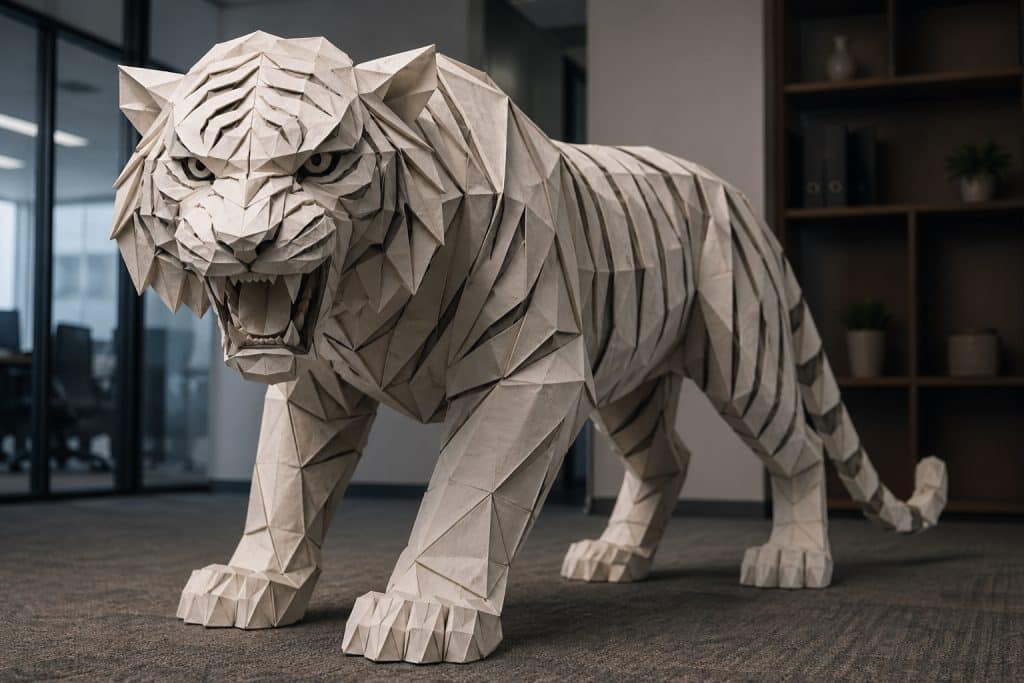
That’s a paper tiger. There is no technical cost or other barriers to deal with. It is just a belief, dressed up as reality, sitting in the room and frightening everyone away from a perfectly good idea. Paper tigers feel solid because they’re woven from things that are real: cultural norms, past experience, and genuine human psychology. The concern that wheeling rather than carrying your bag impacted masculinity reflected something true about attitudes at the time. The mistake was assuming those attitudes were permanent, and that the practical benefits of wheels would never outweigh them.
Paper tigers show up everywhere. “Our customers aren’t ready for that.”; “Nobody will pay for something they used to get free.”; “That’s just not how this industry works.”
They are repeated in meetings as if they’ve been tested, although most of the time, they haven’t. And the people who say them most confidently are often the most experienced; the insiders who know exactly how things have always been done and have quietly mistaken that for how things must be done. That’s where it gets tricky.
Experience is valuable. It helps us move faster and avoid mistakes. But experience teaches you what has been true, not necessarily what will be. Markets shift, attitudes evolve, and things change. A constraint that was real in one decade can quietly dissolve in the next, leaving behind only the echo of an assumption that nobody thought to question.
Some constraints are real and ignoring them creates real problems, but instead of assuming this is the case, perhaps we should ask better questions. Questioning if the belief has been tested or whether it’s a fact and not a story we’ve been telling each other long enough that it started to feel like one can make a difference.
Most paper tigers don’t hold up to much pressure. The ones that do were real constraints all along (not paper tigers), and now, at least, you know. You’ve replaced a vague fear with a concrete fact, which is always a better place to work from.
The wheeled suitcase was always a good idea. It just had to wait for someone willing to test a tiger made of paper.
“It ain’t what you don’t know that gets you into trouble. It’s what you know for sure that just ain’t so.” – Mark Twain
What’s a “paper tiger” you’ve seen, in your business or your own thinking, that turned out not to be real?
Have a good weekend.
-Vijay